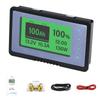
• [More Accurate Power Measurement] This battery monitor adopts a more accurate SOC algorithm and allows importing custom battery SOC curves. Supports DC 8-100V wide voltage range, covers the measurement needs of most devices. High resolution of 0.01V accurately captures minute voltage changes and avoids data errors. The built-in automatic calibration function allows continuous measurement accuracy to be maintained even after long-term use.
• [More Practical New LED Screen] The battery monitor uses a new wide viewing angle LED screen, and by combining the PVC gel sheet on the surface, data can be clearly viewed under any light environment. The battery status is intuitively displayed without the need for complicated operations by changing the number of LED indicators lit and their colors. Built-in temperature monitoring function effectively prevents the risk of overheating and over-discharge
• [Data retention function during power outage] Equipped with a highly reliable memory function during power outage, power energy data is automatically saved and permanently retained even after a power outage, eliminating the need for manual backup. This completely eliminates the worry of data loss due to unexpected power outages. The battery monitor also has a flexible reset function, allowing you to independently erase historical data if necessary, without worrying about data redundancy or the risk of accidental deletion.
• [Voltage alarm notification] The battery fuel meter can freely set the voltage alarm and overcharge/overdischarge thresholds, and the alarm standards for overcharge voltage (battery capacity exceeds 100%) and overdischarge voltage (battery capacity below 10%) can be adjusted according to actual needs. When the battery status reaches the set threshold, the device will issue a timely warning without the need for manual monitoring. This effectively prevents battery damage due to overcharging and overdischarging.
• [Compatible with multiple batteries] The battery monitor is compatible with a variety of battery types, including ternary lithium batteries, iron lithium batteries, and lead-acid batteries (acid batteries). There is no need to purchase separate inspection equipment for each battery of different standards, and it supports individually configurable battery parameters. Inspection standards can be adjusted according to the characteristics of each battery, meeting all usage needs. It combines versatility and specialization, making it more flexible and hassle-free to use.


 No-delivery refund