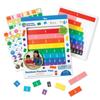
[Learn with Fraction Cards] Learning fractions involves various steps. The included fraction cards divide fraction learning into 24 steps, with problems designed to deepen understanding of each unit. With full-color illustrations, children can visually and intuitively learn the mechanics of fractions by assembling and disassembling blocks in response to the questions on each card.
[Instructions for Parents Included] Want to support your child but find it difficult to explain? To address this, we've included instructions for parents. Each step includes instructions on how to use the blocks and key points to focus on during the learning process. Please make use of these instructions.
[Conversion of Fractions, Decimals, and Percentages (%)] These blocks can be used not only for fractions but also for learning decimals and percentages (%). While understanding the relationship between fractions, decimals, and percentages (%) all involves understanding the relationship to "1," trying to understand this solely through mental effort can be confusing for children due to the complex thought process. Learning intuitively using the blocks helps organize the thought process and leads to a deeper understanding.
[Before they develop a dislike for it] "Percentages" is one of the top three most difficult topics in upper elementary school math. Fractions, decimals, and percentages (%) are fundamental to percentages. Leaving them unresolved can significantly impact future learning. To prevent developing a dislike for it, please use fraction blocks for support at home.
[Learning tailored to your child] By using fraction blocks for home learning, you can ensure your child learns at their own pace. They can skip sections they already understand and work through the difficult parts until they grasp them, leading to deeper learning. Also, because lessons at school progress among many friends, children often can't ask questions even if they're confused. At this age, they may even start to feel embarrassed to ask questions. Please use fraction blocks at home for preparation and review, allowing your child to think carefully on their own. Target age: 6 years and older
![Apricity [Math Blocks Set] Includes Step-Up Cards To Deepen Understanding of Fractions, Decimals, and Percentages (%) & Parent's Instruction Manual -](https://img.joomcdn.net/59d341284cb43eb61573523937017fdc8e557370_1024_1024.jpeg)
![Apricity [Math Blocks Set] Includes Step-Up Cards To Deepen Understanding of Fractions, Decimals, and Percentages (%) & Parent's Instruction Manual -](https://img.joomcdn.net/d0fedeb9db437fcc6ddcc80e4d6febfb21661b4d_1024_1024.jpeg)
![Apricity [Math Blocks Set] Includes Step-Up Cards To Deepen Understanding of Fractions, Decimals, and Percentages (%) & Parent's Instruction Manual -](https://img.joomcdn.net/7d98c149558c5af594bce9730d7509ed37365a3f_1024_1024.jpeg)
![Apricity [Math Blocks Set] Includes Step-Up Cards To Deepen Understanding of Fractions, Decimals, and Percentages (%) & Parent's Instruction Manual -](https://img.joomcdn.net/d3ba5fccb5aec59543f5cf2e10ae81bab1e9cc17_1024_1024.jpeg)
![Apricity [Math Blocks Set] Includes Step-Up Cards To Deepen Understanding of Fractions, Decimals, and Percentages (%) & Parent's Instruction Manual -](https://img.joomcdn.net/4e7ded6269bc113f371a81d2f7f83840f110f409_1024_1024.jpeg)
![Apricity [Math Blocks Set] Includes Step-Up Cards To Deepen Understanding of Fractions, Decimals, and Percentages (%) & Parent's Instruction Manual -](https://img.joomcdn.net/144fd29a4671ea1ff3ae6cb0f67a20ef896aaf7f_1024_1024.jpeg)
![Apricity [Math Blocks Set] Includes Step-Up Cards To Deepen Understanding of Fractions, Decimals, and Percentages (%) & Parent's Instruction Manual -](https://img.joomcdn.net/be7473b99baae76e4f868fafee97dd36052cb2cc_1024_1024.jpeg)


 No-delivery refund


![Apricity Block Cards To Deepen Understanding Parent Instructions Included Math Teaching Materials [Math Set] Fractions, Decimals, Percentages, Step-up](https://img.joomcdn.net/59d341284cb43eb61573523937017fdc8e557370_100_100.jpeg)
![HapiChil Fraction Learning: Imaginable Fraction Blocks & 24 Step-Up Cards [Supervised by Veteran Cram School Instructors] (Fractions/Decimals/Percenta](https://img.joomcdn.net/ead61fd7e6b7ab70b4edd7b39bc9bc61549eeb79_100_100.jpeg)

![Can Understand Fractions with HapiChil First Fraction Learning Set Fraction Puzzles Fraction Tiles Includes Fraction Master Textbook [You Images] &](https://img.joomcdn.net/5e8835a02e6701d763b5c72d61cb8fed00253905_100_100.jpeg)
![[Understand Fractions Through Images] HapiChil's First Fraction Learning Set: Fraction Puzzles & Fraction Tiles (Magnetic Compatible) with Fraction Ma](https://img.joomcdn.net/a8a6fc973ba15d15192c5d1849fb816891be2b94_100_100.jpeg)



![Alban Mahjong Color Dot Stick Full Set+ Score Record Book [Score Record Book] 1 Book 8 Tiers With 100 Sheets](https://img.joomcdn.net/00e0b5156f61cfac4c9219214f948a1a451c249e_99_100.jpeg)

![Mahjong Colored Stick Full Set Score Record Book Record 1 Book Included 8 100 Sheets + [score Book] Rows,](https://img.joomcdn.net/364f4505761c31be1079656c23df4d67d4e1814b_100_100.jpeg)