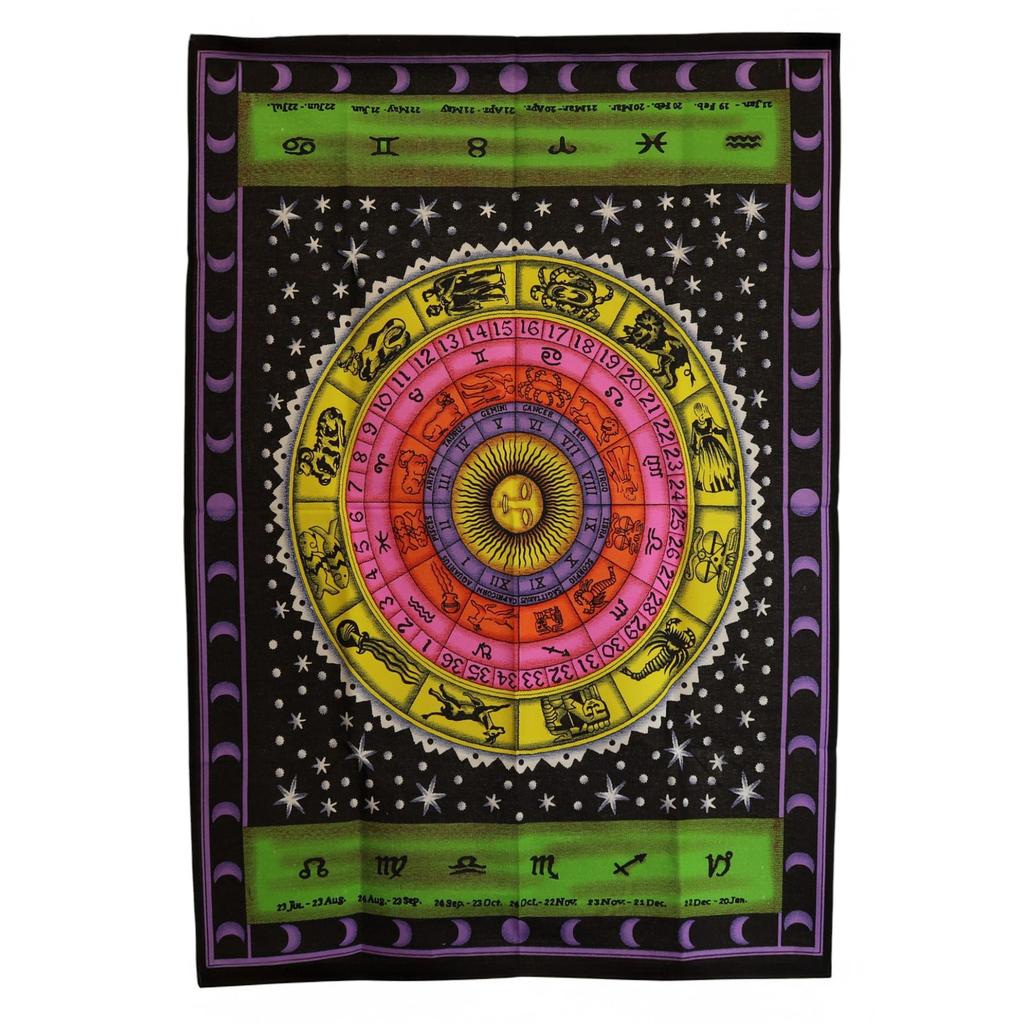
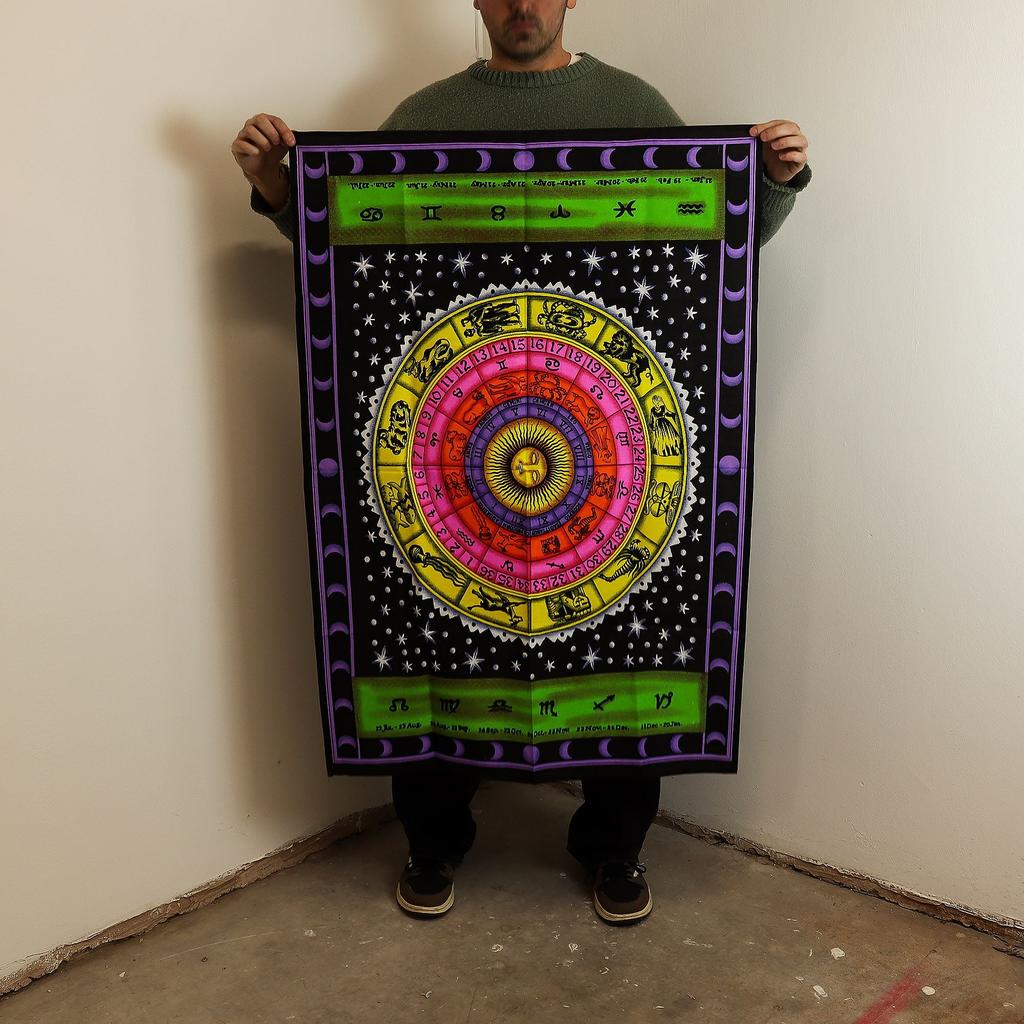
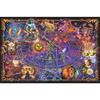
A screen-printed cotton wall hanging centred on a zodiac wheel — all twelve signs arranged in a circular composition surrounded by stars, lunar phases, and colour gradients that shift across the design. This is a cosmic, celestial-themed hanging in vivid colour: blues, purples, oranges, and golds blending outward from the central wheel. It's the most explicitly astrological design in the wall art range — where the Circle of Life hanging includes zodiac signs as one element among several, this one makes the zodiac the entire subject. 70cm wide by 110cm tall, 95 grams, made in India.
What You're Getting
The zodiac wheel sits at the centre with all twelve signs represented around it. The circular format is how zodiac charts have been depicted for centuries — signs arranged in sequence around a ring, each occupying its section of the sky. The visual effect is orderly and symmetrical despite the colour richness around it. Stars and celestial details fill the space between the wheel and the edges of the hanging.
The colour palette uses gradients — colours blending into one another rather than sitting in flat, defined blocks. This gives the design a more atmospheric quality than the other colourful hangings in the range, which tend toward solid colour areas. The gradient effect suggests sky, light, and cosmic space, which suits the astrological theme.
Lunar phases appear as part of the composition. The moon cycle — new to full and back — is one of astrology's foundational references, and its inclusion alongside the zodiac wheel creates a more complete celestial picture than the star signs alone would.
All twelve signs are present, which gives the hanging a built-in conversation piece. Anyone who walks into the room will look for their sign. That interactive quality — people scanning the wheel to find their own section — is something none of the other hangings in the range provoke in quite the same way.
The colour intensity and celestial theme give this hanging a sense of depth and space that the flatter, more graphic designs in the range don't have. Where the Om and Yin Yang hangings read as surface pattern, this one tries to create the impression of looking into something — sky, cosmos, night.
Screen-Printed Cotton
Lightweight cotton, hemmed edges, screen-printed on one side. The gradient colour effects are achieved through overlapping ink applications during the screen-printing process — a technique that requires careful registration to avoid muddying the colour transitions. The result is a soft blend between tones rather than hard edges. The inks are matte and sit on the cotton with the same slightly absorbed quality as the rest of the range. Uncoated, unlined fabric. Reverse shows a faded impression.
Where to Hang It
No hardware included. Pins, tacks, adhesive hooks, or clips — 95 grams.
The cosmic colour palette — blues, purples, and deep warm tones — makes this hanging naturally suited to bedrooms and evening-lit spaces. The colours are rich under warm lamp light and moody under low light, which aligns with the celestial subject matter. It also works in living rooms as a statement piece, or in any room where the occupant has an interest in astrology and wants that reflected on the walls.
Against dark walls (navy, charcoal, deep green), the hanging extends the room's colour story and the zodiac wheel appears to float against the surrounding darkness. Against white or light walls, it creates a strong focal point with high contrast. Either approach works — the design is saturated enough to hold its own in both contexts.
Hand wash gently in cold water if needed. Do not machine wash. The gradient colours are more subtle than solid blocks — fading will show as a loss of depth in the colour transitions rather than an obvious lightening. Keep away from sustained direct sunlight. Iron on the reverse at low heat.
The Zodiac as a Picture
The zodiac wheel is one of the oldest ways humans have organised the night sky into something legible. The twelve-sign system used in Western astrology traces back to Babylonian astronomy — roughly 2,500 years ago — where astronomers divided the ecliptic (the apparent path of the sun through the sky over a year) into twelve equal segments, each associated with a constellation. The Greeks inherited and formalised this system, naming the signs and weaving them into the mythology that still accompanies them: Aries the ram, Taurus the bull, Gemini the twins, and so on.
What makes the zodiac unusually suited to visual art is its structure. Twelve segments in a circle. Each with its own symbol, its own associated imagery, its own personality. The format practically demands illustration — it's a natural wheel, a natural chart, a natural clock. Zodiac imagery has appeared in mosaics, manuscripts, cathedral floors, astronomical instrume