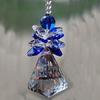
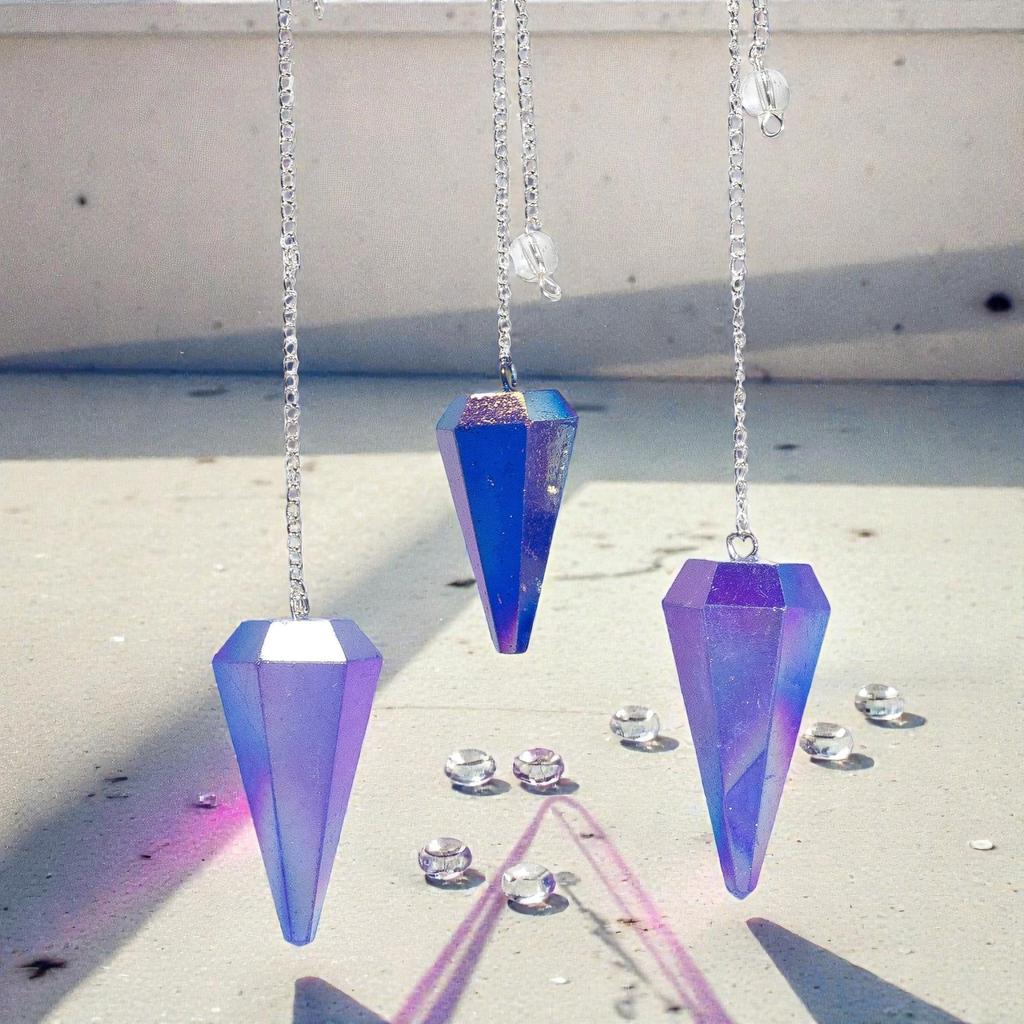
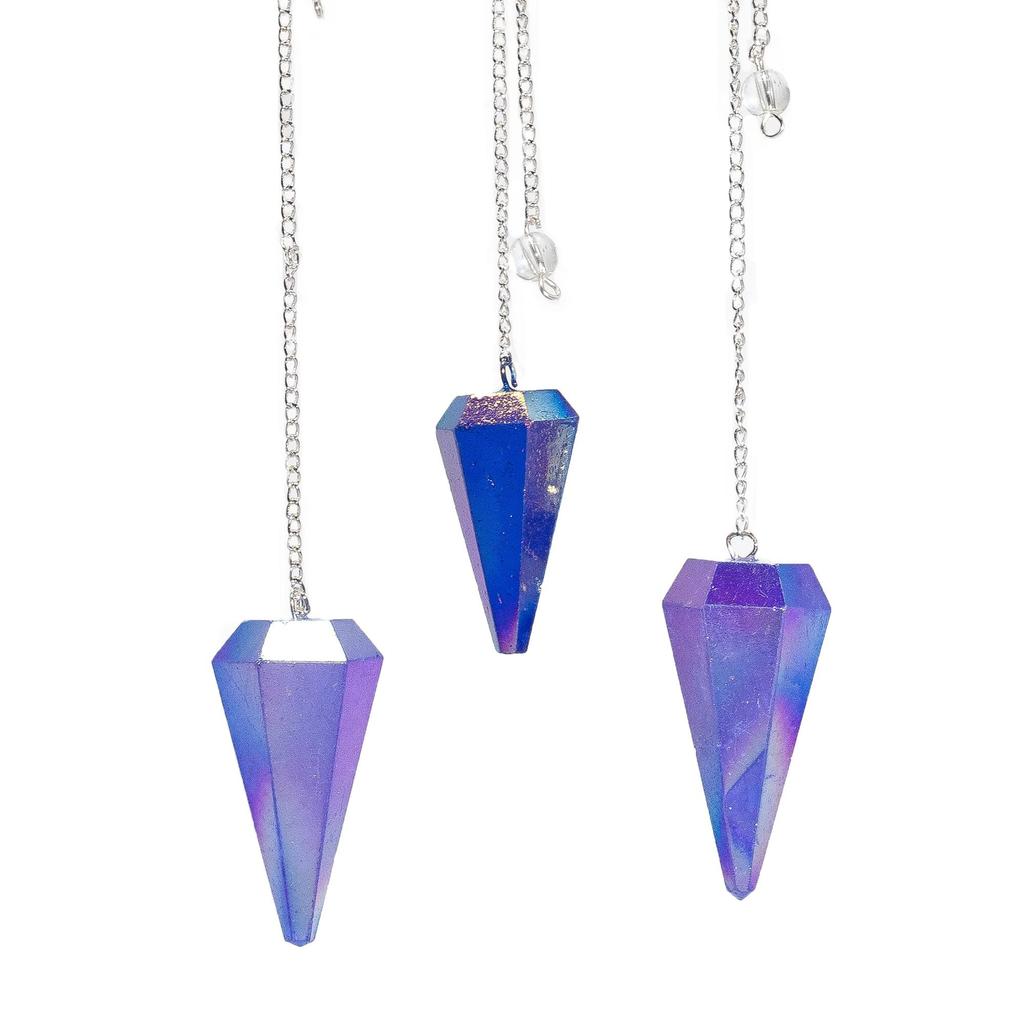
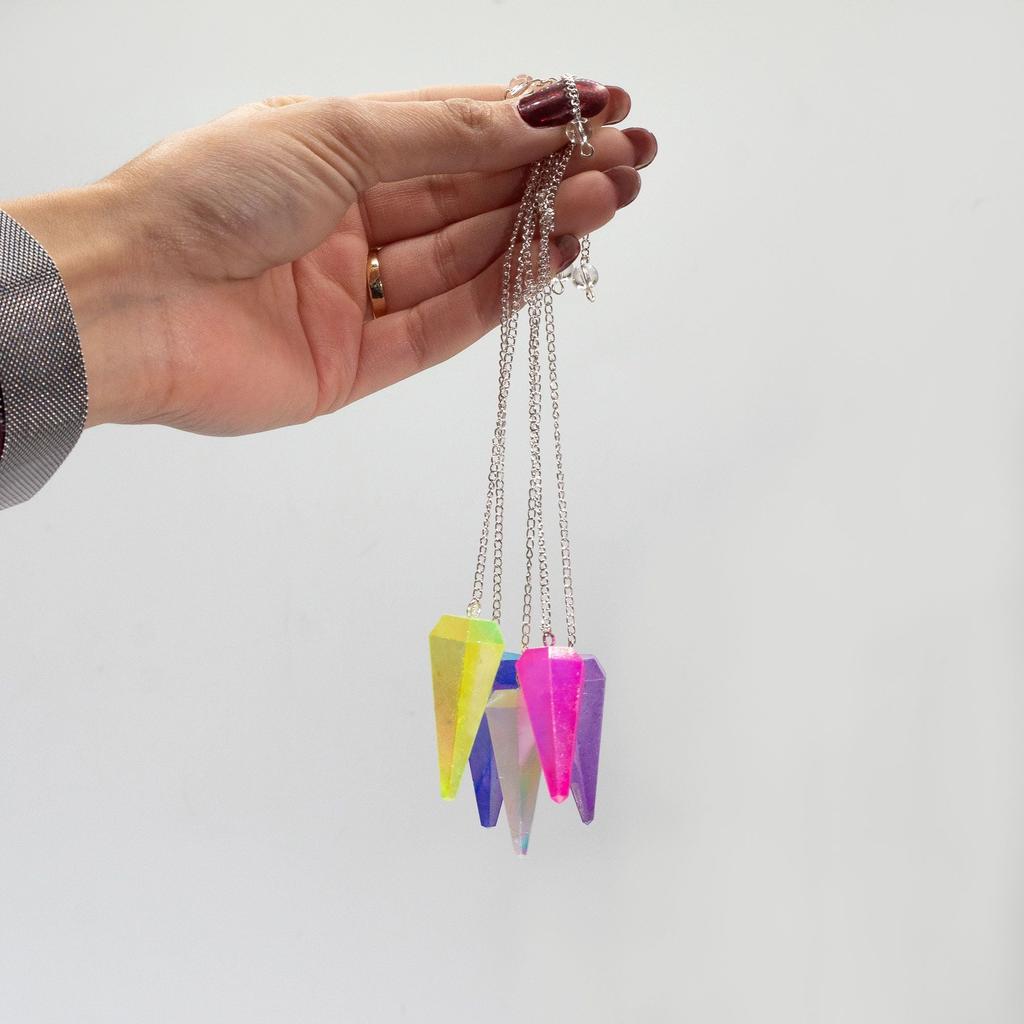
A small blue crystal pendulum for quiet divination practice, faceted into a clean six-sided point that catches light in lilac, violet and deep blue. Hold the chain loosely, let your hand settle, and use the movement as a reflective way to focus a question rather than rush an answer.
What you’ll notice in the hand
The polished point has a cool, glassy look, with shifting blue and purple tones as it turns.
Its six-sided shape gives it a clear centre line, so the form feels balanced and purposeful.
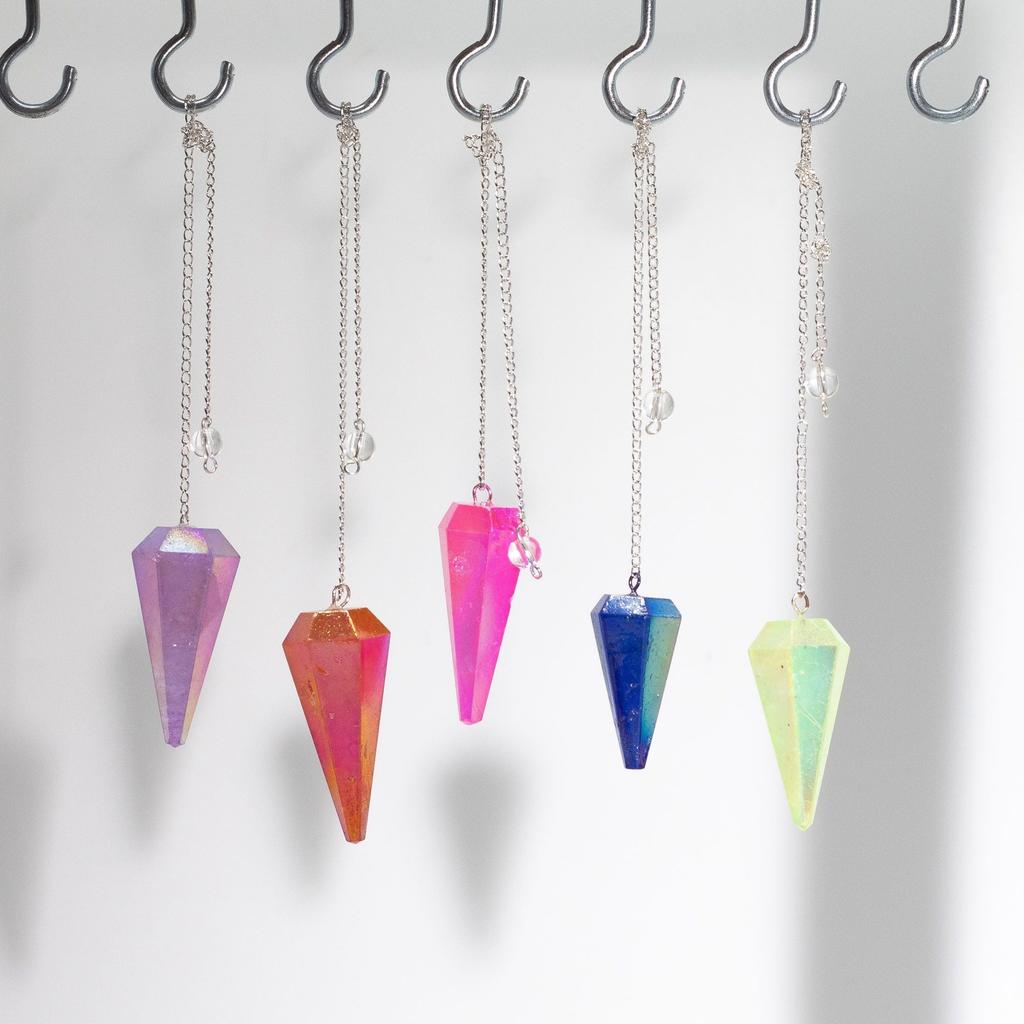
The silver-coloured chain lets the pendulum hang freely, with a small clear bead at the end for holding.
The surface has a soft aurora sheen, almost like evening light on water.
When not in use, it can rest or hang as a tiny sculptural object on a desk, altar or shelf.
Blue aurora crystal and orgonite
This pendulum is made with chipstones, wire and orgonite. The finish is polished and faceted, so the light moves across flat planes rather than a rounded surface.
Using it as a reflective practice
Hold the end bead or chain between your fingers and let the point hang still. Take a moment before asking a clear, simple question, then watch the movement without forcing it.
Pendulums are often used in dowsing, meditation and intention-setting as tools for attention. Their movement can also be understood through the ideomotor effect, where tiny unconscious hand movements shape the swing.
Care for the polished point
Keep it dry, and wipe the surface with a soft cloth after handling. Store it where the point will not knock against harder objects, as polished crystal finishes can pick up small marks over time.
A small history of the hanging weight
The word pendulum comes from the Latin for ‘hanging’, and the object has appeared in many forms, from scientific timekeeping to folk dowsing practices. In Europe, dowsers historically used hanging weights or rods to seek water, while later spiritual and parlour traditions gave pendulums a more reflective, question-bas…
region of manufacture: India


 No-delivery refund
![[Sedona Magic] Frost Point Dowsing Ice Pendulum Frost Point Natural Stone Quartz](https://img.joomcdn.net/990ad71c3c1fdd5cc7a7da886d16612d85a33dca_100_100.jpeg)




![[Magic of Sedona] Diamond-Shaped Orgonite Pendulum (Lapis Lazuli) World Tree Pendulum, Power Stone, Dowsing, Divination, Orgone Power](https://img.joomcdn.net/83d8aed22b679289a4eff013ad720e055446b75e_100_100.jpeg)
![[AiO JAPAN] Purified Before Shipping. Pendulum, Power Stone Crystal, Feng Shui, Hexagram, Dowsing, Pendulum, Fortune Telling (Amethyst)](https://img.joomcdn.net/b5968c86eb8c1a106ab17aaf7ca28ff59c1b7d15_100_100.jpeg)