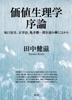
I'm the type who always pursues dreams with friends," "I feel more at ease when I'm alone." Naturally, values, which influence our preferences and even our personalities, differ from person to person. They are cultivated through experience, influenced by the era and environment in which we grew up. However, if we consider these values to be innate and physiologically determined, then the way we interpret their works also changes.
Focusing on three figures—Sakaguchi Ango, Dazai Osamu, and Kamei Katsuichiro—who were all born around the same time to wealthy families in northern Japan, this book carefully examines their respective ideas and beliefs, taking into account the historical context of the Marxist movement and World War II, revealing the existence of standards within their values.
Based on social interactions and the resulting physiological tolerance for stress, this book infers three types of human values and demonstrates that value consciousness and value judgments differ depending on these types. Furthermore, by examining thinkers and writers from all over the world, past and present, from Kant and Nietzsche to Oe Kenzaburo and Murakami Haruki, it becomes clear that these three types can be seen across time and circumstances.
In today's society, where division among people is a growing concern, this profound book will make you reconsider what human values are.
Table of Contents
Introduction
Part 1: Ango Sakaguchi, Osamu Dazai, and Katsuichiro Kamei
Chapter 1: Katsuichiro Kamei and Ango Sakaguchi through Adolescence
1. Katsuichiro Kamei's Path
2. Katsuichiro Kamei's Characteristics Inferred from His Adolescence
3. Ango Sakaguchi's Path
4. Ango's Characteristics Revealed from His Adolescence
Chapter 2: Introduction to "Interpersonal Stress Tolerance" from the Two Men's Adolescence
1. Introduction to "Interpersonal Stress Tolerance"
2. Introduction to "System Stress Tolerance"
3. Life Trajectories Inferred from Interpersonal Stress Tolerance
Chapter 3: Kamei Has High Interpersonal Stress Tolerance
1. Kamei's High Interpersonal Stress Tolerance Is Presumed to Be High—Based on His Trajectory, Mainly Up to His Early Twenties
2. Kamei's Trajectory as a High Interpersonal Stress Tolerance from Adolescence onward
3. Kamei Katsuichiro Has High Interpersonal Stress Tolerance
Chapter 4: Ango Has Low or No Interpersonal Stress Tolerance
1. Ango's Low or No Interpersonal Stress Tolerance Is Presumed—Based on His Trajectory, Mainly Up to His Early Twenties
2. Ango's Trajectory from Adolescence onward—A Trajectory of Low or No Interpersonal Stress Tolerance
3. Ango's Idealism—Low or No Interpersonal Stress Tolerance, No Idealism, or Weak Ideals and the Denial of Strong Ideals
4. Ango's Anarchist Nature—Low Interpersonal Stress Tolerance? None
5. Ango's Realism (Anti-Idealism) - Low or No Tolerance to Interpersonal Stress
6. Ango's Social Activism - Low or No Tolerance to Interpersonal Stress
7. Ango's Religious Awareness - Low or No Affinity for Prayer
8. Ango's Awareness of History, Tradition, and Culture - Low or No Posthumous Honor and Achievement Evaluation - Low or No Tolerance to Interpersonal Stress
9. Ango's Tolerance to Interpersonal Stress - Low or No
Chapter 5: Dazai's Early Life and Adolescence - Estimated to Have Medium Tolerance to Interpersonal Stress
1. Medium Tolerance to Interpersonal Stress - Dazai's Emergence
2. Dazai's Growth Experiences from Childhood
3. Dazai's Path to Youth
4. Dazai's Reaction to the Grand Ideal ("Grand Narrative") of Marxism
5. Based on his external and internal trajectory up to adolescence, Dazai is estimated to have "Medium Tolerance to Interpersonal Stress"
Chapter 6: General Considerations for "Medium Interpersonal Stress Tolerance"
1 Trust and faithfulness, a "medium-strength belief in the existence of others," are appropriate for those with moderate interpersonal stress tolerance.
2 The "medium-strength group" that moderate interpersonal stress tolerance refers to.
3 The "medium-strength ideal" for those with moderate interpersonal stress tolerance.
4 "Moderate Interpersonal Stress" and "Moderate Interpersonal Stress Tolerance"
5. High Guilt Awareness, Moderate Guilt Recognition, Moderate Guilt Consciousness within Interpersonal Stress Tolerance
6. Moderate Faith, Moderate Prayer Affinity within Interpersonal Stress Tolerance
7. Moderate Solidarity, Moderate Social Movement within Interpersonal Stress Tolerance
8. Moderate Awareness of History, Tradition, and Culture within Interpersonal Stress Tolerance, Moderate Posthumous Honor and Achievement Recognition
9. Summary of Characteristics of Moderate Interpersonal Stress Tolerance
Chapter 7: Dazai's Trajectory from Adolescence onward—Moderate Interpersonal Stress Tolerance
1. Reaction to the Grand Ideal ("Big Story") and the Greater East Asia Co-Prosperity Sphere Idea—Middle Ideal, Moderate Collective Side, Moderate Solidarity
2. Dazai is Moderately Collective Side—Middle Interpersonal Stress Tolerance
3. Dazai's "Medium Intensity of Belief in Others" and His Emphasis on "Trust," "Faith," "Friendship," "Sympathy," and "Humanity"—Middle Interpersonal Stress Tolerance
4. Dazai's Middle Ideal Personality - "Semi-strong idealism," "Intermediate principle," "Ideology that sublimates opposing values," and "Eclecticism": Medium tolerance for interpersonal stress
5. Dazai's high awareness of guilt, medium recognition of guilt, medium sense of guilt, and "failure as a human being (medium tolerance for interpersonal stress)"
6. Dazai's medium faith and medium affinity for prayer
7. Dazai's medium solidarity and medium social activism
8. Dazai's awareness of history, tradition, and culture, medium posthumous honor and achievement evaluation
9. Interpersonal stress Summary of Dazai's Interpersonal Stress Tolerance
Chapter 8: Mutual Criticism between Kamei, Dazai, and Ango - Mutual Criticism between Those with High/Medium/Low or None Interpersonal Stress Tolerance
1. The Physiology of Mutual Criticism
2. Mutual Criticism between Dazai and Kamei
3. Mutual Criticism between Dazai and Ango
4. Indirect Mutual Criticism between Kamei and Ango
5. Summary of Mutual Criticism between Those with High/Medium/Low or None Interpersonal Stress Tolerance
Part 2: To the World and the Present
Chapter 1: Introduction to "Value Physiology" - The Significance of the "Three Types of Interpersonal Stress Tolerance"
1 What is the "Three Types of Interpersonal Stress Tolerance"?
2 The Significance of the "Three Types of Interpersonal Stress Tolerance"
Chapter 2 Application of the "Three Types of Interpersonal Stress Tolerance" - Modern Japanese Literature
1 Natsume Soseki: High Interpersonal Stress Tolerance
2 Endo Shusaku: Low or None Interpersonal Stress Tolerance
3 Oe Kenzaburo: High Interpersonal Stress Tolerance
4 Murakami Haruki: Low or None Interpersonal Stress Tolerance
Chapter 3 Application of the "Three Types of Interpersonal Stress Tolerance" - Philosophy and Thought of the World
1 Kant: High Interpersonal Stress Tolerance
2 Hegel: Medium Interpersonal Stress Tolerance
3 Nietzsche: Low or None Interpersonal Stress Tolerance
4 Philosophical Content Determined by Interpersonal Stress Tolerance
5 Marx: High Interpersonal Stress Tolerance
Chapter 4 Application of the "Three Types of Interpersonal Stress Tolerance" Theory—Modern Japanese Philosophy and Thought
1. Yoshimichi Nakajima: Low or No Interpersonal Stress Tolerance
2. Yoshinori Kobayashi: Medium Interpersonal Stress Tolerance
3. Kentoshi Furuichi: Low or No Interpersonal Stress Tolerance
Chapter 5: Introduction to "Value Physiology"—Summary of the "Three Types of Interpersonal Stress Tolerance" Theory
1. Summary of Part 1—Kamei Katsuichiro: High Interpersonal Stress Tolerance, Dazai Osamu: Medium Interpersonal Stress Tolerance, and Sakaguchi Ango: Low or No Interpersonal Stress Tolerance
2. Summary of Part 2
Afterword